The Pharmaceutical Nanotechnology (PNT) Laboratories are a research group in the Division of Pharmacy and Optometry at The University of Manchester. We design nanomedicines that respond to the biology around them, and we build the in vitro models needed to test them honestly — with the aim of delivering drugs to places where conventional formulations fail, above all the brain.
Who we are
The lab was founded in November 2022 and is led by Dr Christos Tapeinos, Lecturer in Pharmaceutical Sciences. It has since grown into an interdisciplinary group of pharmacists, materials scientists, chemists and cell biologists working at the interface of pharmaceutics, nanotechnology and cell biology, and now numbers around eighteen people — PhD students, postdoctoral researchers and project students.
That mix is deliberate. A nanoparticle that works in a vial and fails in tissue is a chemistry problem solved and a biology problem ignored; keeping synthesis, characterisation and cell work in the same group is what stops the two drifting apart.
What we work on
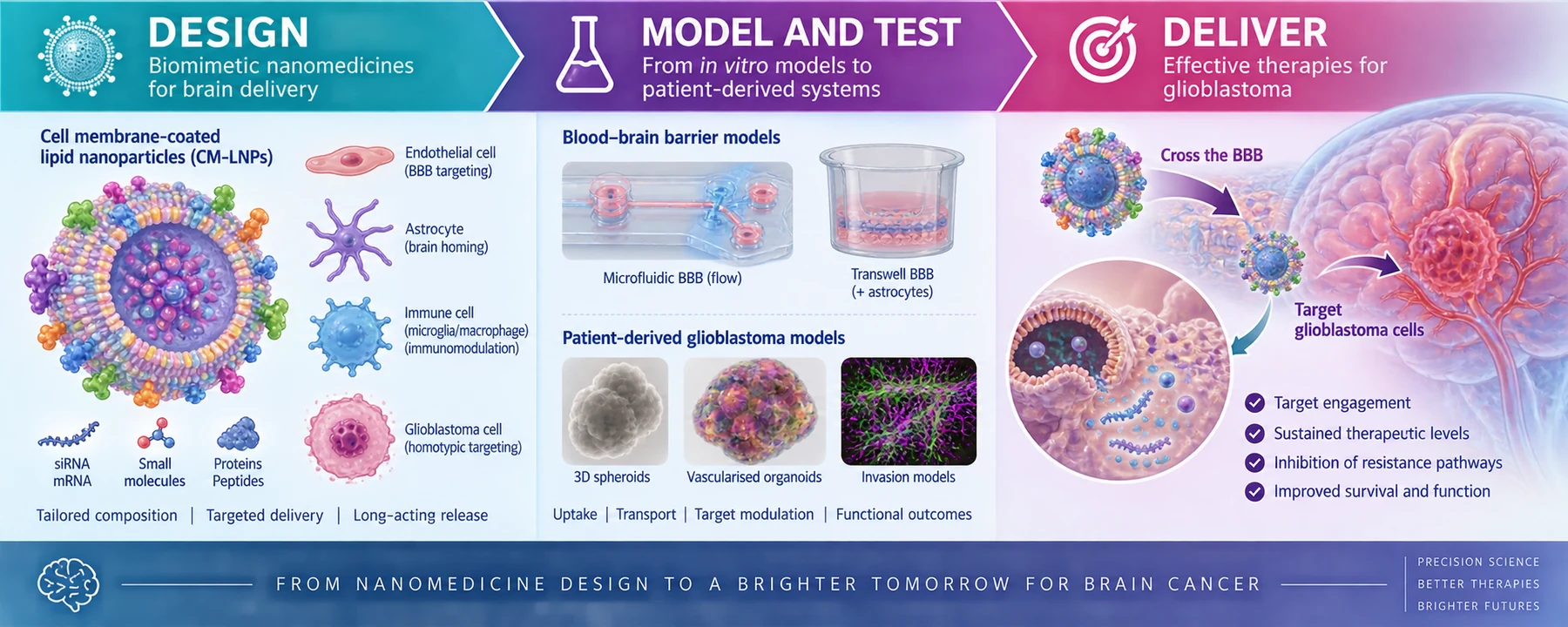
Our work centres on three diseases where delivery, rather than the drug itself, is usually the limiting step: glioblastoma, neuroinflammation and pancreatic cancer. Each is protected by a barrier or a microenvironment that keeps therapeutics out, dilutes them, or switches them off before they act.
Across those diseases we pursue six themes: smart nanomedicines for the brain, cell-membrane-derived nanoparticles, cell–material interactions, the tumour microenvironment, microfluidic in vitro models, and long-acting therapeutics. They are less separate programmes than different views of one question — how a material behaves once it meets living tissue. Each is described under research themes, and the grants currently funding them are listed under projects.
How we work
Our aim is delivery systems that “read” their microenvironment — pH, redox state, enzyme activity, temperature — and respond in predetermined, controlled ways, rather than releasing their cargo on a fixed schedule regardless of where they have ended up.
Work in the lab runs from nanoparticle synthesis and single-particle characterisation through to 3D cultures and microfluidic organ-on-chip models. We test every system in models that reflect the relevant biology before moving in vivo, which is slower at the start and considerably faster afterwards. It is also how we think the number of animal experiments is most realistically reduced: by making the in vitro stage good enough to be worth believing.
Where we are
The lab is based in the Stopford Building on Oxford Road, on the University’s main campus and next to the Manchester Royal Infirmary. The proximity matters: much of what we do depends on access to patient-derived material and on conversations with the clinicians who treat these diseases.
Funding and partners
Our research is supported by the Marie Skłodowska-Curie Actions, The Royal Society, the EPSRC and Translation Manchester, alongside University of Manchester schemes. We collaborate with academic groups across the UK and Europe, and with companies developing nanomedicines, biomaterials and in vitro models.
Working with us
We are usually glad to hear from well-matched PhD applicants, fellowship candidates and visiting researchers; current openings are listed under join us. Companies interested in collaborative research or consultancy can find how we typically work together on the industry page. For anything else, the quickest route is to get in touch.